
Understanding Non-Convulsive Seizures
When Seizure Activity Has No Visible Signs
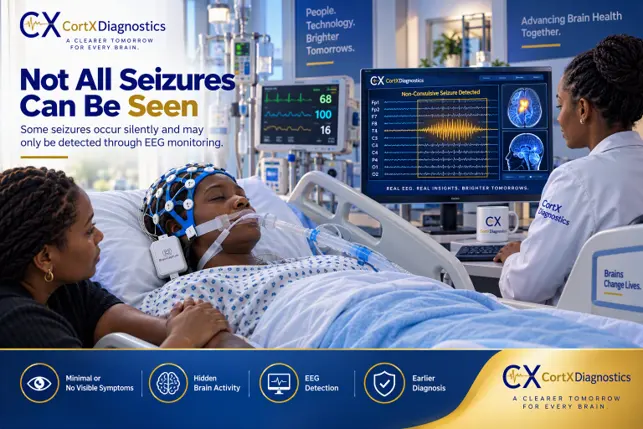
A non-convulsive seizure (NCS) occurs when abnormal electrical activity develops in the brain without the dramatic shaking typically associated with seizures. Because physical signs may be subtle or absent, these events are often referred to as silent seizures.
Patients may appear:
- Confused or disoriented
- Excessively drowsy
- Unresponsive
- Staring blankly
- Slow to respond to commands
- Experiencing fluctuating levels of awareness
In some cases, there may be no outward signs at all, and the seizure can only be detected with an electroencephalogram (EEG).
Who Is at Risk?
Non-convulsive seizures are commonly seen in patients with:
- Stroke
- Traumatic brain injury
- Brain hemorrhage
- Cardiac arrest
- Brain infections
- Brain tumors
- Epilepsy
- Metabolic disturbances
- Critical illness requiring ICU care
Why Are They Difficult to Detect?
Unlike convulsive seizures, non-convulsive seizures may not cause obvious movements. Symptoms can easily be mistaken for:
- Fatigue
- Medication effects
- Delirium
- Confusion
- Sedation
- Underlying neurological illness
As a result, seizure activity may continue unnoticed unless EEG monitoring is performed.
The Role of EEG
EEG is the most reliable way to identify non-convulsive seizures and determine:
- Whether seizure activity is present
- How often seizures are occurring
- Whether treatment is effective
- If ongoing seizures are contributing to altered consciousness
Why Early Detection Matters
Undetected seizure activity may interfere with recovery and can progress to non-convulsive status epilepticus (NCSE), a prolonged seizure condition requiring urgent medical attention.
Early EEG monitoring allows clinicians to identify hidden seizure activity, guide treatment decisions, and provide the highest level of neurological care.
Non-Convulsive Status Epilepticus (NCSE)
Ongoing Seizure Activity Without Visible Convulsions
Non-Convulsive Status Epilepticus (NCSE) is a serious neurological condition in which seizure activity continues in the brain for a prolonged period without the obvious shaking typically associated with seizures.
Because there may be little or no visible movement, NCSE can be difficult to recognize without EEG monitoring.
What Does NCSE Look Like?
Patients with NCSE may experience:
- Persistent confusion
- Reduced responsiveness
- Unexplained drowsiness
- Sudden changes in behavior
- Staring spells
- Memory or attention difficulties
- Fluctuating levels of consciousness
- Stupor or coma
In critically ill patients, there may be no visible signs at all, making EEG essential for diagnosis.
Who Is at Risk?
NCSE is more likely to occur in individuals with:
- Epilepsy
- Recent convulsive seizures
- Stroke
- Traumatic brain injury
- Brain hemorrhage
- Brain infections
- Brain tumors
- Cardiac arrest
- Severe metabolic disturbances
- Critical illness requiring ICU care
Important: this article is general information only. It does not replace advice from a qualified healthcare professional. In an emergency, contact your local emergency medical service immediately.